The product
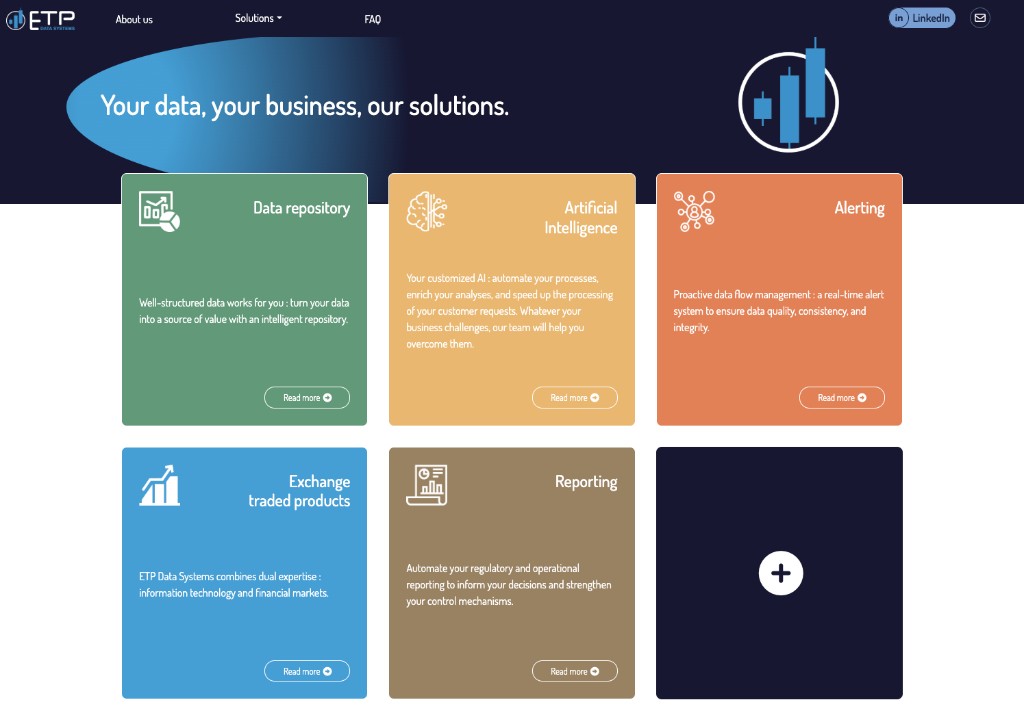
ETP Data Systems, founded in 2010 in Paris, combines information technology and financial markets. The line is “your data, your business, our solutions”: turn complex market data into operational intelligence for issuers, distributors, and clients of exchange-traded products.
The core product goal was to standardize listed derivative option products—especially turbos and related warrants—so issuers no longer ran one-off product definitions and clients no longer compared incompatible catalogs. Shared product models, barrier and lifecycle events, and a client-facing map of listed instruments sat on one lifecycle instead of issuer-specific tools.
Solutions
The platform is modular: an intelligent data repository so structured data becomes a source of value; real-time alerting to keep data quality, consistency, and integrity; automated regulatory and operational reporting; and exchange-traded product coverage that uses dual IT and market expertise.
The company later expanded from critical real-time market-data management into workflow automation, data-quality monitoring, and AI that analyzes, contextualizes, and generates high-value content—including customized process automation and faster handling of client requests.
Scale
Public company figures today: more than 100,000 financial instruments monitored on an ongoing basis, about 56 million data points processed every day, and 15+ years of data expertise. Recent market commentary from ETP cites €3.17 billion in Q1 2026 trading volume on its AFPDB scope (14.4% vs Q4 2025, 29.6% year-over-year) and an EcoVadis Silver rating retained in 2026.
Where I started
I started on the rewrite of the backend that would automate the product lifecycle: ingest, validate, persist, and emit ProductFlow and BarrierEventFlow instead of manual, issuer-by-issuer processes.
That meant a new data model, stored procedures, REST services, and reference-data rules so product creation, barrier hits, and real-time updates could run without operators stitching feeds by hand.
Turbo Map and issuer/client extranet
With that backend in motion I built frontend surfaces for a multi-issuer Turbo Map and the client/issuer extranet—the product issuers and clients used to inspect listed turbos and related market context.
Those screens sat on the new SQL Server model, stored procedures, and REST workflows so reference data stayed consistent as issuers onboarded products.
Reference data and service workflows
I improved web-service workflows and added reference-data anomaly handling so bad or incomplete issuer feeds could be caught before they reached the extranet.
Stack on this platform: ASP.NET, C#, SQL Server, REST APIs, SSRS, SSIS, Bootstrap.
Load testing before migration
Ahead of a platform migration I helped build a load-testing tool that simulated ProductFlow, BarrierEventFlow, and real-time market data, so operators could see how the stack behaved under pressure before cutover.
Runbooks and issuer onboarding
I wrote recovery, backup, and incident runbooks for the database and platform, plus an issuer onboarding questionnaire so new issuers could be brought onto the extranet with a repeatable checklist rather than ad-hoc tribal knowledge.
Marketing site and product search
I improved UX/UI on widgets, the application, and reports, then built the public marketing site at www.etpdatasystems.com with integrated derivatives-product search.
That site used ASP.NET MVC 5, jQuery, Bootstrap, and SQL Server.
What I learned
Standardizing derivative options only works if the backend automates the lifecycle. ETP taught issuer vs client needs, real-time flows, and that load tests and runbooks sit next to the Turbo Map, not after it.